
Researchers from the Institute of Metal Research of the Chinese Academy of Sciences have developed a new class of high-performance materials for micro-electromechanical system (MEMS) switch chips, achieving an ultra-long fatigue life critical for 5G/6G communications, aerospace, industrial control and medical applications.
The study was published in Acta Materialia on November 5.
MEMS switches, which contain micro-cantilevers capable of undergoing 10 billion bending cycles, require materials combining excellent conductivity, high strength, and exceptional fatigue resistance. Gold and its alloys have been widely used due to their low resistivity and microfabrication compatibility; however, their limited strength and fatigue performance fall short of demanding longevity requirements.
In this study, the researchers led by Prof. ZHANG Guangping have developed nanocrystalline Ni/Ni-W laminated composites demonstrating remarkable fatigue durability. Using their self-developed ultra-high-cycle fatigue testing system for micro-materials, the researchers discovered that the fatigue performance of the novel material surpasses current required lifetime threshold by approximately 60% when subjected to one billion bending cycles.
This breakthrough stems from unique self-regulating mechanisms activated during fatigue loading. Nanograin rotation in the Ni-W alloy layer initiates atomic diffusion pathways, driving Ni atoms from smooth Ni/NiW interfaces toward rough interfaces. This creates a chemical composition gradient, with W-depleted regions near rough interfaces enhancing deformation compatibility and stress concentration resistance.
Meanwhile, W-rich regions near smooth interfaces promote the continuous formation of high-density nanotwins and stacking faults, which significantly reduces cyclic plastic strain accumulation.
According to the team, the synergistic action of "nanotwin-assisted limited grain coarsening" and a "diffusion-mediated chemical composition gradient" inhibits strain localization and delays the evolution of fatigue damage.
Building on this breakthrough, the researchers are collaborating with domestic companies to integrate the new micro-cantilever material into standard MEMS manufacturing processes, achieving a "zero-to-one" advance. This study paves the way for next-generation solid-state switch and radio-frequency relay chips.
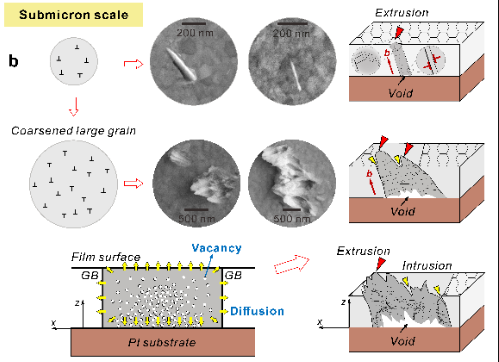
Prof. ZHANG Guangping and his research team from Institute of Metal Research have revealed the vacancy-dominated fatigue mechanism at smaller scales through quantitative analysis of fatigue damage.

86-10-68597521 (day)
86-10-68597289 (night)

52 Sanlihe Rd., Xicheng District,
Beijing, China (100864)
Copyright © 2002 - Chinese Academy of Sciences


